
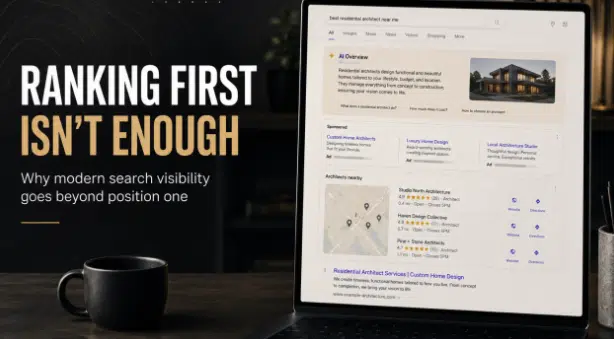
For years, ranking first in Google was treated as one of the clearest indicators that an SEO strategy was working. If a page held the top organic position, businesses expected traffic to follow.
That relationship is becoming less predictable.
Google is testing larger and more dynamic AI Overviews, and in some searches those summaries can now expand automatically, pushing traditional organic results further down the page. Depending on the query, a user may encounter an AI Overview, sponsored ads, a local map pack, video results, directories, or other search features before reaching the first traditional organic listing.
So when a client tells us, “We still rank first, but our clicks are down,” the answer cannot simply be that the ranking report looks good.
We have to look at what ranking first actually means inside the search result they are competing in.
The Search Result Has Become Much More Crowded
Google has been in an extensive testing and development phase since AI search became more widely adopted by the public. The amount of space being consumed by AI generated results continues to change, and the visual hierarchy of the search results page is changing with it.
That creates both a visibility problem and a click through rate problem.
A business may still technically hold the first organic position while appearing much farther down the screen than it did several years ago. If an AI Overview answers the initial question, several ads appear below it, and a local pack follows, the traditional number one result may require a meaningful amount of scrolling before it is even visible.
The position stayed the same.
The experience around that position changed.
That is why I think ranking reports need more context than they once did.
Marketers Need to Review the Actual Search Result
Rank tracking is still valuable. We use it extensively, and I do not think ranking data is becoming irrelevant.
What is changing is how much we can infer from the position by itself.
Marketers have relied heavily on ranking reports for a long time because they provide a clean, understandable metric. The problem is that the live search environment has become much more volatile.
If we are evaluating search visibility today, we should also be paying attention to local pack placement, paid advertisements, AI citations and mentions, video results, directories, third party platforms, click through rate, site traffic, and how users actually interact with the website once they arrive.
That produces a much more diversified view of whether the marketing strategy is working.
A page holding position one while losing qualified traffic deserves investigation. A page dropping a few positions while maintaining leads and conversions may not deserve the same level of concern.
The business outcome still has to matter more than the ranking number.
High Intent Pages Become Even More Important
As Google answers more informational questions directly in the search result, I think protecting high intent pages becomes increasingly important.
There is a major difference between losing traffic from a broad informational article and losing traffic to a core service, product, or location page.
If an AI Overview satisfies someone who only wanted a basic definition, that lost click may not have been particularly valuable to the business anyway.
But if a person is searching for a specific service in a specific city, comparing products, researching pricing, or showing another clear sign of commercial intent, those searches deserve much more attention.
This is where I think SEO strategies need to become more selective.
Instead of focusing purely on how much organic traffic a website produces, we should be asking which pages continue to attract users who are actually capable of becoming customers.
If total traffic falls while high intent traffic and conversions remain healthy, the business may not have lost nearly as much as the top line analytics report suggests.
There Is Still an Unresolved Value Exchange
There is a larger issue here that I do not think has been settled yet.
Publishers have spent years creating the information Google uses to build its search experience. AI Overviews can now summarize that information without necessarily sending the user to the website that helped provide the answer.
A recent field experiment involving 1,100 Google Search users found that removing AI Overviews and AI Mode increased click through rates to publishers, adding more evidence that generative search experiences can reduce outbound traffic.
Google, for its part, continues to argue that AI search creates new opportunities for discovery and says it is designing these experiences to highlight websites and original content. The company also says AI Overviews now reach more than 2.5 billion monthly active users.
I think there has to be a sustainable value exchange in the long run.
If publishers continue investing in research, expertise, service pages, product information, and useful content, but the search engine increasingly consumes that information without returning meaningful value, businesses will eventually have less incentive to keep producing it.
I do not think we know exactly where that balance settles yet.
Fewer Clicks Could Still Mean Better Clicks
There is another side to this that I am more optimistic about.
AI search may reduce some of the early research clicks that historically came to websites, but the people who eventually do click may arrive much farther along in the decision process.
We are starting to see early evidence supporting that idea.
Shopify reported that AI referred shoppers converted at roughly twice the rate of organic visitors in some research intensive product categories. Separate industry data analyzed by Search Engine Land found LLM referral traffic converting at 20% within one dataset, although these numbers will vary significantly by industry and should not be treated as universal benchmarks.
That makes sense to me conceptually.
If someone spends more time researching through an AI platform before visiting a company’s website, they may arrive with fewer basic questions, a clearer understanding of what they want, and a shorter path toward conversion.
We should not assume that will happen for every business, but it is something worth watching closely.
The future may involve less traditional organic traffic while the traffic that does arrive becomes more qualified.
SEO Success Needs a Broader Scorecard
This is why I think businesses need to become less dependent on any single SEO metric.
Rankings matter.
Traffic matters.
But neither tells the full story anymore.
We should also understand click through rate, high intent page performance, local visibility, branded search, AI citations, assisted conversions, engagement, phone calls, form fills, purchases, and ultimately whether the search strategy is helping produce customers.
That does not mean every metric deserves equal attention.
It means the scorecard has to reflect how search actually works today.
A company may be performing extremely well in search while receiving fewer overall clicks than it did a few years ago. Another company may have thousands of new AI impressions without generating a meaningful amount of business from them.
Context matters more than ever.
The Goal Is Not Just to Rank First
I still want our clients to rank first.
There is nothing wrong with pursuing strong organic positions, and traditional SEO fundamentals continue to be extremely important.
But ranking first is no longer the finish line it once appeared to be.
Businesses now have to understand what appears above them, what appears around them, whether people are still clicking, which searches actually matter, and what those users do once they arrive.
As AI Overviews continue taking up more of the search results page, marketers will have to become better at distinguishing between lost traffic and lost business.
Those are not always the same thing.
And if AI search ultimately sends fewer but more qualified users to publisher websites, the businesses that focus on intent, conversion quality, and customer outcomes will be in a much better position than the ones still measuring SEO success primarily by ranking position and total sessions.