
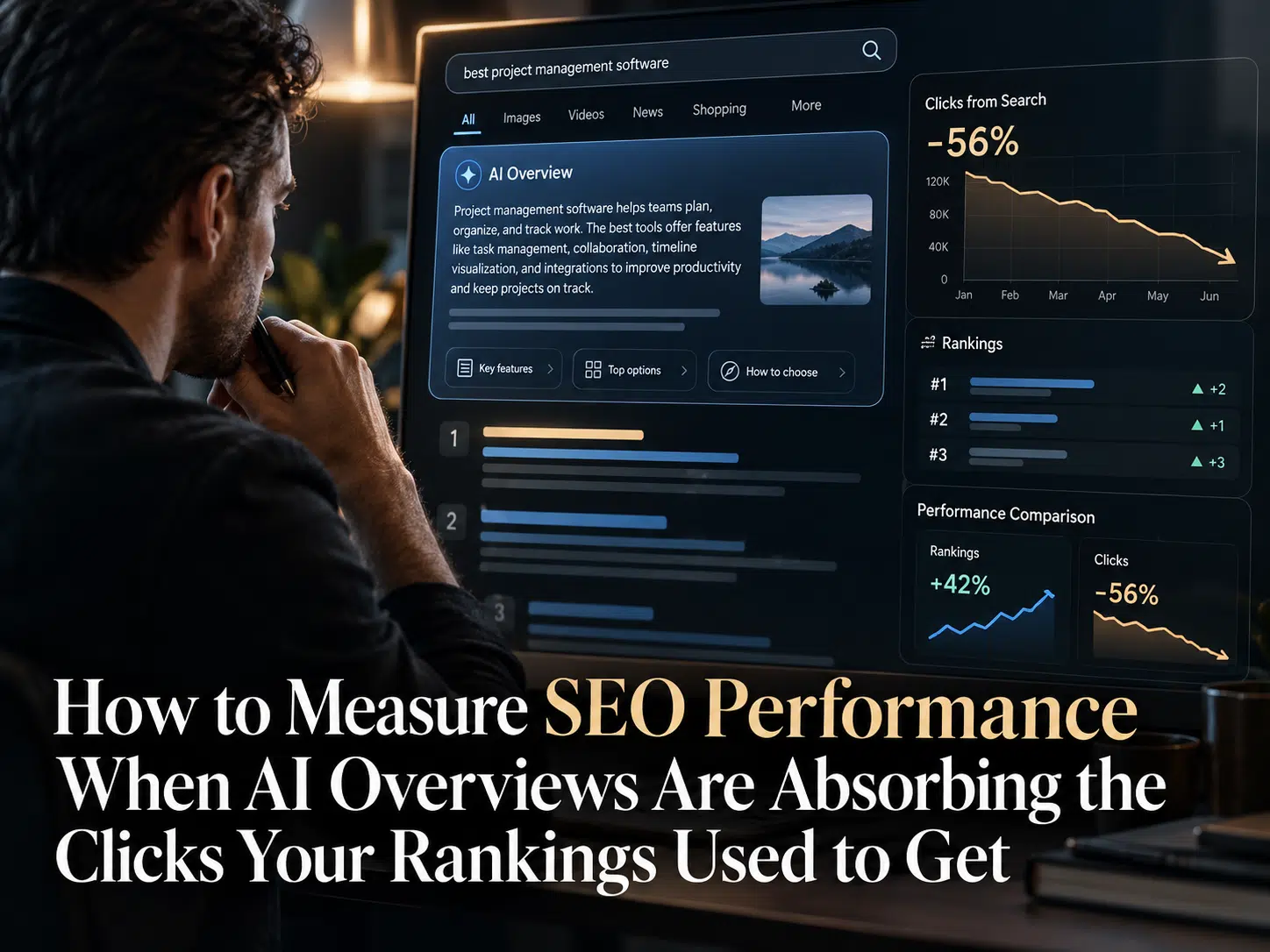
To measure SEO performance now, you have to look past clicks and rankings, because AI Overviews are answering searches before anyone reaches your site. Your page can rank first, get quoted in the summary at the top, and still lose the click to a reader who got what they needed without scrolling.
That shift breaks the old scoreboard. Traffic dips while visibility stays strong, and the numbers you trusted for years suddenly tell a confusing story.
The fix is not panic. It is a better set of metrics. Below, you will learn why old measurements fall short, which numbers actually reflect success now, and how to prove your marketing is working even when clicks decline.
Why is it harder to measure SEO performance with AI Overviews?
It is harder to measure SEO performance because AI Overviews answer questions on the results page, so high rankings no longer guarantee traffic. Google pulls a summary from several sources and shows it above the links, and many searchers stop there.
That creates a gap between visibility and clicks. You can appear in the answer, build trust with the reader, and never see them arrive in your analytics.
Informational searches feel this most. Queries like “how does X work” or “what is X” often get fully answered in the overview, so the click that used to follow simply disappears.
What exactly changed in the search results?
Google added a summary box that uses artificial intelligence (AI) to write a direct answer from multiple websites. Instead of a plain list of links, the top of the page now holds a paragraph that often satisfies the search on its own.
For your reader, that means faster answers. For your reporting, it means fewer clicks tied to the same, or even better, visibility.
What SEO metrics actually matter now?
The SEO metrics that matter now are impressions, brand searches, qualified leads and conversions, not just clicks and rankings. These numbers track whether people see you, trust you and act, which is what your marketing is actually paid to do.
Start by widening your definition of success. A drop in clicks paired with a rise in leads is a win, not a loss.
Focus on these five signals:
- Impressions, which show how often you appear in search and AI answers, even when the click does not follow.
- Qualified leads, meaning inquiries from people who can actually buy, not raw traffic counts.
- Conversions, such as calls, form fills and booked appointments tied back to search.
- Branded searches, or how often people look for you by name after seeing you elsewhere.
- Assisted conversions, which reveal when search played a role earlier in the buyer’s path.
Clicks still count. They just stop being the whole story.
How do you measure SEO performance when clicks are dropping?
You measure SEO performance during a click decline by pairing visibility metrics with business outcomes, then reading them together. One number alone will mislead you. The pattern between them tells the truth.
Here is the practical method. Compare your impressions and your conversions over the same window.
If impressions hold steady or rise while clicks fall, AI Overviews are likely absorbing the traffic, not stealing your visibility. That is a reporting problem, not a performance problem, as long as leads stay healthy.
Which tools give you the clearest picture?
Google Search Console gives you the clearest view of impressions, click-through rate and the exact queries where you appear. Watch for queries where impressions climb but clicks slide, since those are the searches AI Overviews are answering for you.
Pair that with your analytics and your customer records. Search Console shows visibility, analytics shows behavior, and your booking or sales data shows revenue.
How do you separate a real problem from a reporting problem?
You separate the two by checking whether leads and revenue moved with the clicks. A real problem shows falling clicks and falling leads together. A reporting problem shows falling clicks while leads and conversions hold or grow.
Track lead quality, not just lead volume. Ten strong inquiries that book beat forty that never call.
If your qualified leads are steady while clicks drop, your search presence is still working. The overview is doing some of the selling for you.
How do you track visibility inside AI answers?
You track visibility inside AI answers by monitoring branded searches, direct traffic and mentions across the tools your customers use. AI Overviews rarely send a clean referral, so you measure the ripple effects instead of the click.
Watch for three signals that show up when AI is quoting you.
- A rise in branded search volume, since people often read your name in an answer, then search for you directly.
- An increase in direct traffic, which suggests readers found you elsewhere and typed your site in later.
- More “unattributed” conversions, where a customer arrives ready to buy with no obvious source.
These are indirect, but they are real. When your name spreads through AI answers and community discussions, demand shows up as people looking for you on purpose.
That connection matters enough to build a strategy around, which is why brand search volume is becoming the most reliable leading indicator of whether your marketing is actually working.
Why do rankings alone no longer prove success?
Rankings alone no longer prove success because a top position can sit below an AI answer that already satisfied the search. Being number one on a page nobody scrolls is a hollow victory.
Rankings still matter as one input. They help you earn the citation and the click when the reader wants more.
But treating position as the finish line hides the real result. The honest question is not “where do we rank,” it is “are we getting seen, trusted and chosen.” Those outcomes now come from many places at once, including the community threads and forums that Reddit and community content are showing up in your clients’ search results and what to do about it explains in depth.
What should you report to prove SEO is working?
You should report the metrics tied to money and trust, framed as a trend, not a single snapshot. Owners care about leads, calls and revenue, so lead with those and use visibility numbers to explain the why.
Build a simple, honest scorecard:
- Qualified leads and conversions first, since these connect directly to revenue.
- Impressions and branded searches next, to show visibility is holding even when clicks shift.
- Cost per lead over time, because efficiency improving is a strong sign of healthy search work.
- Assisted conversions, to credit search for its role early in the buyer’s journey.
Show the trend across three to six months. One month is noise. A quarter is a message.
How do you know your SEO is still on track?
You know your SEO is on track when visibility holds and business outcomes climb, even if raw clicks soften. Use these checkpoints to judge your next move instead of reacting to a single scary number.
- Compare impressions and clicks in Search Console, since rising impressions with falling clicks usually points to AI Overviews, not lost visibility.
- Check whether qualified leads held steady or grew over the same period, because that is the clearest sign your search presence still works.
- Watch your branded search volume month over month, as a steady rise means more people are seeking you out by name.
- Track cost per lead across a full quarter, since a falling cost signals your marketing is getting more efficient.
- Review lead quality alongside volume, because fewer, better inquiries often beat a flood of clicks that never convert.
If most signals point up while clicks dip, your strategy is working. The scoreboard just changed.
What Customers Often Ask
Are AI Overviews really taking my traffic?
AI Overviews take some clicks, mostly on informational searches where the reader wants a quick answer. High-intent and branded searches usually still send visitors to your site. Check Search Console for queries where impressions rise but clicks fall to confirm the pattern.
Should I stop tracking rankings entirely?
No, keep tracking rankings, but treat them as one signal among several. A strong position still helps you earn the AI citation and the click when someone wants more detail. Pair rankings with impressions, leads and conversions for the full picture.
How do I show my boss that SEO is working with fewer clicks?
Report leads, conversions and cost per lead instead of clicks alone. If those numbers hold or improve while impressions stay strong, your search presence is doing its job. Show the trend across a full quarter so one slow month does not distort the story.
What is the single best metric to watch now?
Qualified leads are the single best metric, since they connect search directly to revenue. Branded search volume is a close second, because it shows growing demand and trust. Together they reveal whether your visibility is turning into real business.
Where This Leaves Your Reporting
To measure SEO performance in the age of AI Overviews, stop grading yourself on clicks alone and start reading impressions, branded searches, leads and conversions together. Your rankings may hold while traffic softens, and that is fine as long as qualified leads and revenue keep climbing.
Watch the trend across a full quarter, separate a reporting shift from a real decline, and report the numbers that tie search to money. That is how you prove your work when the old scoreboard stops making sense.
If you want a clear, honest read on whether your search strategy is still delivering, talk to a specialist at Massif.co about the metrics that matter for your business.