
Google Ads continues to expand its automation capabilities, taking over more of the decisions that used to sit directly with advertisers.
AI Max can expand search matching, generate customized ad copy, and choose different landing pages through Final URL expansion. Google is also automatically upgrading some campaigns that already use campaign-level broad match or text customization into AI Max during September 2026.
There is plenty to debate about how much control advertisers should hand over to these systems, but I think there is a more immediate issue businesses need to pay attention to.
The more Google automates, the more important your conversion data becomes.
Poor conversion tracking used to be primarily a reporting problem. You could look at the wrong numbers and make the wrong decision.
Now it can become a training problem.
If Google is making more decisions based on the conversions you feed back into the system, inaccurate or low quality signals can actively teach the campaign to pursue the wrong outcomes.
Google Will Optimize Toward What You Tell It Is Valuable
Automation is ultimately trying to achieve the goals we give it.
The problem is that Google does not inherently know the difference between a meaningful sales opportunity and an action that happens to be easy to generate.
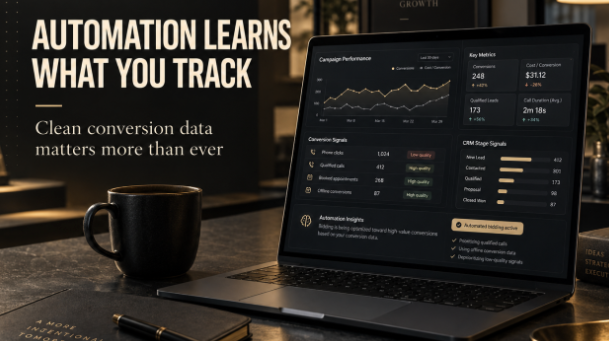
Consider phone calls.
A click on a phone number tells us that someone showed interest, but it does not necessarily mean a qualified conversation happened. Someone could click accidentally, hang up immediately, ask an irrelevant question, or call for something completely unrelated to the service being advertised.
I would rather treat that action as a lower value signal and qualify the actual conversion based on something more meaningful, such as call duration or, ideally, downstream information about whether the call became a legitimate lead.
The same principle applies to forms.
A simple form submission may technically be a conversion, but if half of those submissions are spam or poor fits, training an automated campaign to produce more of them does not necessarily improve the business.
Google is very good at finding efficient ways to generate the actions we tell it matter.
That makes defining those actions correctly increasingly important.
The Easiest Conversion Is Not Always the Best Conversion
This is the risk I see as Google expands automation.
If several conversion actions are available, the system can naturally gravitate toward the outcomes it can produce efficiently.
That can look great in the advertising dashboard.
Conversion volume rises. Cost per conversion falls. The automated campaign appears to be improving.
Meanwhile, the sales team may be saying the leads are getting worse.
That disconnect is why I think advertisers need to become much more selective about what qualifies as a primary conversion.
A qualified form submission, confirmed appointment, meaningful phone call, or actual sale gives the system much better information than a simple page interaction or phone number click.
The closer the conversion event gets to real business value, the more useful it becomes as an optimization signal.
Tracking Problems Can Become Campaign Problems
There is another part of this that does not get enough attention.
The data also has to reach Google correctly.
If click IDs disappear, UTM parameters are stripped, form platforms fail to preserve attribution, or different systems stop communicating correctly, marketers may lose the connection between the original ad interaction and the eventual customer.
That does not only create a messy report.
It can weaken the feedback Google receives about which campaigns, searches, ads, and users are actually producing valuable outcomes.
This is why attribution setup deserves more attention as campaigns become increasingly automated.
Website tracking, Google Ads, Analytics, forms, call tracking, and CRM systems should work together as cleanly as possible.
The goal is to create a reliable path between the ad interaction and the eventual business result.
Qualified Lead Data Is Where This Gets More Powerful
The best case scenario is not simply tracking more conversions.
It is passing better conversions back into the system.
For lead generation businesses, that may mean importing offline conversion information after the initial inquiry.
Google’s enhanced conversions for leads is specifically designed to improve attribution between online leads and later offline outcomes. Advertisers can provide customer information along with offline conversion data so Google can more accurately connect later lead activity back to the original ad interaction.
That opens the door to optimizing around much more meaningful stages.
Instead of telling Google that every form fill is equally valuable, a business may eventually be able to distinguish between an inquiry, a qualified lead, a booked appointment, and a closed customer.
That is a much better dataset for automation to learn from.
The same applies to call quality or CRM stages when those systems can be connected effectively.
The more closely the conversion data reflects what the business actually wants, the more useful automated bidding and targeting can become.
More Automation Raises the Standard for Human Oversight
I do not think the takeaway is that businesses should avoid Google Ads automation.
Automation can do things at a scale that would be extremely difficult to manage manually.
AI Max can use broader search signals, customize messaging, and direct people toward different landing pages based on predicted relevance. Those capabilities can create opportunities that a tightly manual campaign might miss.
But giving the system more freedom increases the importance of the instructions we provide.
The advertiser’s job increasingly becomes defining success, protecting the boundaries, and reviewing whether Google’s version of efficiency matches the business’s version of success.
That requires accurate conversion actions, negative keywords and exclusions, appropriate landing page controls, clean attribution, and regular feedback from the people actually handling the leads.
Automation does not eliminate strategy.
It makes bad strategy easier to scale.
Feed the System the Outcome You Actually Want
The simplest way I explain this is that automated advertising learns from the environment we create for it.
If we tell Google that every phone number click is valuable, it will try to generate more phone number clicks.
If we tell it every form submission is equally valuable, it will pursue form submissions.
If we can tell it which leads became qualified opportunities, appointments, or customers, we are giving it a much better definition of success.
That distinction is becoming more important as Google takes control over more parts of the campaign.
Clean conversion tracking should no longer be viewed as something marketers set up simply so the monthly report works.
It is one of the core inputs influencing how the campaign behaves.
The more automation Google introduces, the more selective advertisers need to become about the data they feed into it.
Because if the system is going to learn from your conversions, you want to make sure you are teaching it the right lesson.