
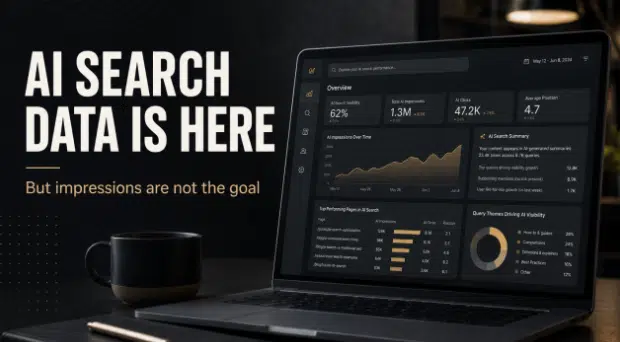
For a while, one of the biggest frustrations with AI search has been measurement.
Businesses have been told that AI Overviews, AI Mode, ChatGPT, and other AI driven search experiences are changing how people discover information, but marketers have had very little first party data showing what that visibility actually looks like.
Google is starting to change that.
Search Console is rolling out a new Generative AI performance report that shows how often a website appears within AI Overviews and AI Mode. For now, the report is primarily focused on impressions, with additional breakdowns by page, country, device, and date. Access is also still being rolled out gradually.
I think this is useful progress.
I also think marketers need to be careful not to immediately turn AI impressions into the next vanity metric.
The First Thing I Want to Know Is Whether the Visibility Makes Sense
If I open this report for a client and see a large number of AI impressions, my first reaction is not necessarily going to be excitement.
I want to understand whether Google appears to understand the business correctly.
Are the pages receiving visibility actually relevant to the company’s services? Does that visibility align with the locations, products, or topics that matter to the business? Or are we seeing signals that suggest Google has a broader or less accurate understanding of what the company does?
At this stage, impressions can be useful as a diagnostic tool.
They may help us understand whether the website, service pages, location content, structured information, and broader business entity are moving in the right direction.
That is valuable.
It just is not the same thing as business performance.
Impressions Are a Starting Point, Not the Goal
This is where I think marketers could get the reporting wrong.
A high number of AI impressions may look impressive in a dashboard, but visibility does not automatically mean that visibility is valuable.
We have dealt with this problem in SEO for years.
A website can gain thousands of impressions for broad informational searches and still produce very little meaningful business activity. Traffic can increase while lead volume stays flat. Rankings can improve for terms that do not actually matter to the business.
AI visibility can create the same problem if we are not careful.
The fact that a business appears in an AI experience tells us something about Google’s understanding and use of its content. It does not yet tell us whether the person seeing that information is a realistic customer.
That distinction is going to matter a lot.
The Data Gets More Interesting When We Can Follow the User
What I am most interested in is what happens as this reporting becomes more granular.
Eventually, I want to understand the relationship between AI visibility and actual user behavior.
If people are clicking from AI search experiences, what does that click through rate look like? How long do those visitors spend on the site? Which pages do they visit? Do they engage with service pages? Do they call? Do they submit forms? Do they become assisted conversions somewhere later in the purchasing cycle?
Those are the questions that start connecting AI search to business outcomes.
Google’s standard Search Console reporting already uses metrics such as impressions, clicks, and click through rate to help marketers understand traditional Search performance. The dedicated generative AI report does not yet provide that same depth, which is why I would be cautious about drawing large conclusions from the early data.
For now, the report gives us another piece of the puzzle.
It does not complete the picture.
Query Intent Will Eventually Matter More Than Total Visibility
Another part of this that will be important is search intent.
If a local service business eventually starts receiving measurable AI traffic from searches that include a city, service, problem, or other strong commercial intent, I am going to pay close attention.
That could be meaningful.
If most of the visibility comes from broad informational questions that are several steps removed from making a purchase, then the value becomes much more subjective.
That does not mean those impressions are worthless. Longer research journeys can still influence awareness and future decisions.
But I would not value a thousand broad informational AI impressions the same way I would value a smaller number of interactions from people who are actively looking for the company’s services in the markets it serves.
This is the same principle we already use when evaluating traditional organic traffic.
Not all visibility has equal business value.
Branded Search Could Become an Interesting Secondary Signal
There is also a potential indirect effect that I think will be worth monitoring.
AI search may introduce people to businesses without immediately sending them to the website.
If those mentions increase awareness, we could eventually see some businesses experience growth in branded searches or direct visits as people research the company later.
I would be interested in that relationship, but I would not automatically treat branded search growth as proof that AI visibility caused it.
That will depend heavily on the industry, the business, its other marketing activity, and the length of the buying cycle.
It is a useful signal to watch, not something I would build the entire measurement strategy around.
This Should Support the Broader SEO Strategy
One reason I like this new reporting is that businesses do not need to reinvent their marketing strategy to benefit from it.
If AI search visibility helps us understand whether Google has a clearer picture of the business, many of the actions that improve that understanding are already good SEO practices.
Clear service pages matter.
Strong location information matters.
Clean website structure matters.
Helpful content matters.
Consistent business information matters.
Third party credibility matters.
The goal should not be to chase AI impressions independently from everything else.
It should be to use the new data as another way to evaluate whether the broader search strategy is making the business easier to understand and easier to discover.
AI Search Data Has to Eventually Connect to Business Outcomes
I am glad Google is beginning to give marketers more visibility into how websites appear in AI search.
More data is better than guessing. But this is also where discipline matters.
We should not look at a rising AI impression graph and immediately declare the strategy successful.
The real value will come as we can better connect that visibility to relevant search intent, meaningful engagement, assisted conversions, qualified leads, purchases, booked appointments, and revenue.
Until then, AI impressions should be treated for what they are: an early signal that can help us understand how Google is interpreting and surfacing a business.
That is useful information. It just should not become another number we celebrate without asking what it actually did for the business.