
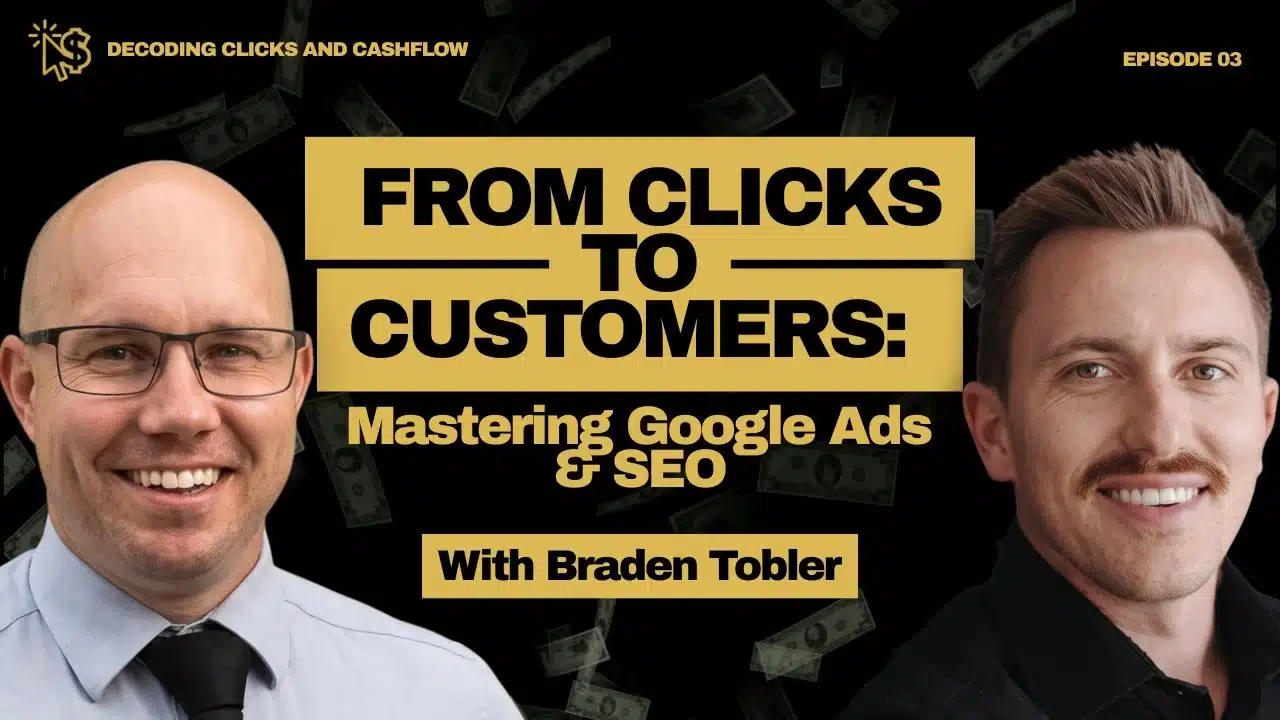
I recently sat down with Tanner Holt, founder of Mach 7 Marketing, for episode 103 of the Decoding Clicks and Cashflow Podcast. Tanner runs a no fluff show for business owners who want to stop guessing with their marketing, so we spent close to an hour on the questions I hear most from service businesses: where to spend a limited budget, how to tell if an agency is any good, and how to know what a lead is actually worth.
Prefer to listen? Catch the full episode on Spotify or Apple Podcasts.
SEO or Google Ads When the Budget Is Tight
This is the question almost every small business asks first. If you need results inside the next six months, paid search is usually the faster path because you can show up for high intent searches right away. SEO is the long game. It compounds over time, and when you invest in the strategies Google already tells everyone to follow, those gains tend to stick.
We also talked about how the rise of AI Overviews and answer engines has not changed the fundamentals as much as people think. People are still searching. The same best practices that earned visibility in Google are the ones that earn mentions in AI results.
Automation Needs Guardrails
Google does everything it can to let you take your finger off the buttons. Smart Campaigns are built to launch fast with as little flexibility as possible, and features like Performance Max and AI Max can spend money on searches you would never choose on your own. That does not make automation bad, but it does mean someone has to steer it.
The basics still carry most of the weight:
- Negative keywords: Keep cutting the searches that will never turn into customers.
- Exact and phrase match: Use tighter match types where intent matters most.
- Location and audience settings: Make sure the ads only show where you can actually serve people.
Business owners are already wearing every hat. Running Google Ads well is a full time discipline, and it is worth having someone accountable for it.
Not Every Lead Is Worth the Same
Attribution came up a lot, and the dental clients we work with are a good example of why it matters. A general dentistry lead might be worth a couple hundred dollars. A cosmetic case can be worth a few thousand, and implant cases are higher still. If all three are counted as one generic conversion, the ad platform has no idea which leads to chase.
When we assign real values to each lead type and feed that data back into Google Ads, bidding starts working toward revenue instead of raw lead volume. That is the difference between a report that looks good and a campaign that actually grows the business.
Make the Next Step Obvious
A landing page has one job. Whether the goal is a form fill, a phone call or a purchase, the next step should be easy to find right away. Keep forms and call to action buttons near the top, make phone numbers clickable throughout the site, and use call assets so people can reach you before they even leave the search results.
Where AI Content Fits
Tanner asked about AI generated content, and my answer was simple: Google cares whether the content is useful. Educational content that people read and engage with can still perform well. Boilerplate listicles that say nothing new are a risk. Use AI to speed up the work, then layer in real human editing and real expertise before anything goes live.
Thanks for the Seat at the Table, Tanner
I appreciated the chance to talk shop with Tanner and the Mach 7 team. If you are a business owner trying to figure out whether your Google Ads and SEO are actually paying off, this episode is a good place to start. And if you want a second set of eyes on your own account, reach out to the Massif team. You can find more of our podcast appearances on our Media and Press page.