
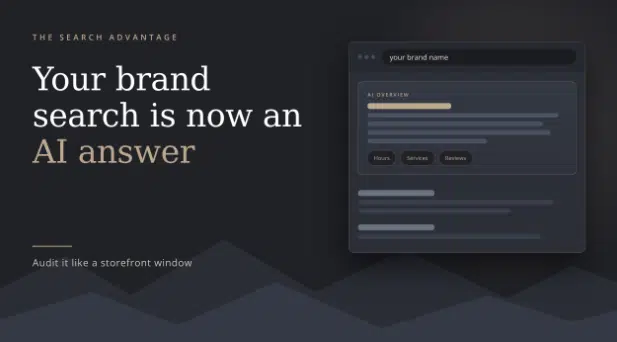
Google has started answering many brand searches with an AI Overview, and on desktop it now often sits in the right-hand column where the knowledge panel used to be.
If someone searches your business by name, the first thing they read may be a summary Google wrote from sources you do not directly control.
Search Engine Roundtable reported on November 2 that Google moved AI Overviews for many brand related searches into the right-hand column of desktop results. The examples were large brands like Apple, Zillow and Coke, the author described it as essentially replacing brand knowledge panels, and PPC Land noted that Google has not announced the change.
I would treat that as a desktop observation for now. I have not found anything showing the same layout on mobile, and the published examples are all national brands. Your own results may look different, which is the reason to check.
Brand Searches Are Showing AI Summaries More Often
Where the summary sits changed, but how often it appears may matter more. Third party trackers show a sharp rise through September. Ahrefs measured AI Overviews on about 83 percent of branded keyword results in its US desktop data by September 29, and DemandSphere saw its tracked branded keywords jump from roughly 26 percent to above 80 percent over the same month.
The trackers disagree on where September started, and these are vendor estimates, not Google data. They all point in the same direction.
Brand Search Is Where Intent Is Highest
I have been saying for a while that AI search mostly serves educational, top of funnel searches, and that high intent conversion still happens through traditional search, paid search, Maps and service pages.
Brand searches sit at the other end of that funnel.
Someone who types your business name already knows who you are. They usually want something specific, like hours, a phone number, directions, pricing, or some proof that the business is real.
That is the traditional search behavior we point to when we say conversion has not moved. It is also now one of the places where Google writes an answer before the customer clicks anything.
We Cannot Say Yet What This Does to Clicks
I would be careful about drawing conclusions. Ahrefs, which published the larger study, argues that click loss is probably not the biggest concern for branded queries. The bigger risk it describes is that third parties can shape how your brand is described.
Google’s reporting does not help much yet. Search Engine Roundtable reported that Gary Illyes implied clicks and queries are unlikely to be added to the Search Console AI report, although he said Google had nothing to announce.
Until that changes, a drop in branded clicks, calls or direction requests is something to investigate. It is not something to blame on AI Overviews without evidence.
A Summary Is Not a Knowledge Panel
A knowledge panel was a set of facts a business could claim, correct and largely control. An AI Overview is assembled from pages Google chooses to cite, and there is no equivalent way to edit it.
In the Ahrefs test of 100 large brands, the outside sources cited most were Wikipedia, YouTube and LinkedIn, which are harder for a business to influence than its own website. PPC Land described one example where the summary and the fact box next to it gave different founding years for the same company.
That is a small mistake for a national brand. For a local service business, the wrong hours, a retired service or an outdated price can cost a phone call.
What I Would Check First
The audit does not need a new tool. It needs a clean browser and a routine.
- Search the business name, then the name with the main service and city, on desktop and on a phone. Write down what appears, where, and the date. Keep dated screenshots as a baseline.
- Compare any AI summary to the website and the Google Business Profile for services, locations, hours, pricing and claims. Note every mismatch and every source it cites.
- Fix mismatches at the source, not in the summary. That means service and location pages, the Business Profile, review responses and the third party listings the summary draws from.
- Check the paid side. Google’s Performance Max help page now says those campaigns may filter out brand searches in favor of dedicated brand Search campaigns, according to PPC Land. If a client relies on Performance Max to catch brand traffic, confirm a brand Search campaign exists, has budget and has accurate copy.
- Repeat monthly. Read branded Search Console clicks, Business Profile calls and direction requests, and branded landing page conversions together before deciding anything moved because of AI.
For clients, I keep the conversation to four points: what changed on the results page, what it could mean for people who already know the business, what we are checking, and what we need from them. That last one is usually confirmation of current hours, services and pricing.
Read the Window Before the Customer Does
A storefront owner checks the window display before opening, because it is the first thing a passerby sees.
Brand search now deserves the same routine.
None of this calls for chasing AI tricks. It calls for knowing what the window says today, correcting what is wrong at the source, and keeping a dated record, so the next change in calls, forms or visits has something to compare against.
Sources
Percentages from Ahrefs and DemandSphere are third party tracker estimates, not Google data.
- Search Engine Roundtable: Google AI Overviews For Brands Move To Right Column (November 2, 2026)
- Search Engine Roundtable: Gary Illyes Implies Click Data Not Coming To Google Search Console AI Reporting (November 2, 2026)
- Ahrefs: AI Overviews Currently Appear for 83% of Branded Searches (October 2, 2026)
- Search Engine Land: Google AI Overviews jump from 26% to 80% of branded queries (October 1, 2026)
- PPC Land: Google moves brand AI Overviews aside as buyers question search budgets (November 3, 2026)